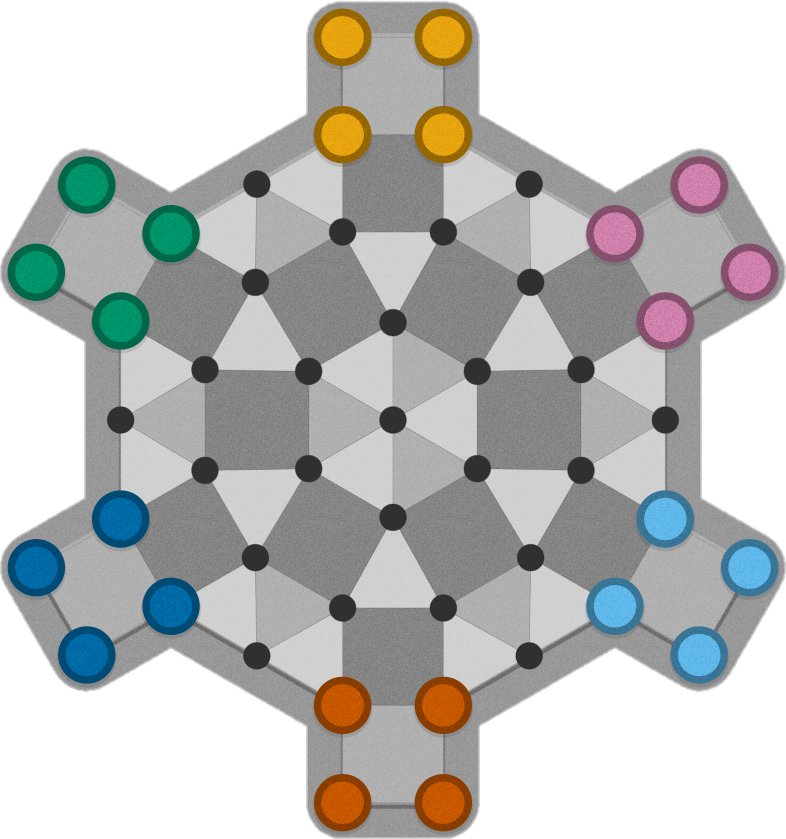
How to play Tarati
Tarati is a two-player abstract strategy game by George Spencer-Brown. This page covers the complete rules. Prefer to learn by doing? The app has an interactive tutorial.
Objective
Capture the last enemy piece in a single move (Mit) or leave the opponent with no legal moves (Stalemit).
The board
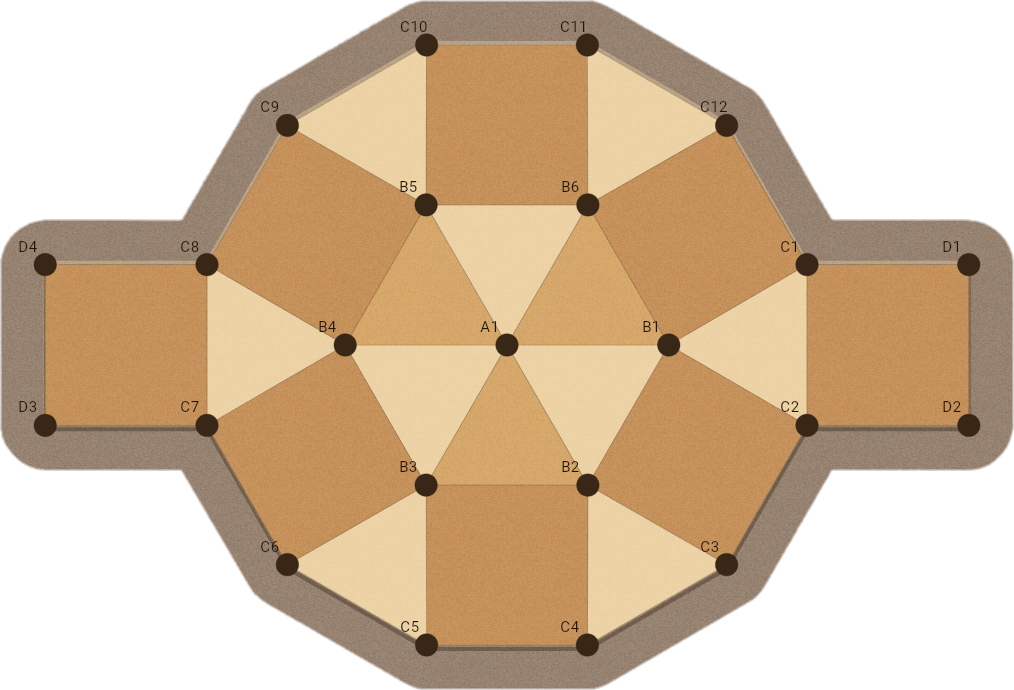
The board has 23 vertices across four zones (not fully disjoint):
- Absolute centre: 1 vertex.
- Bridge: 6 vertices connecting the centre to the circumference.
- Circumference: 12 vertices forming the outer ring.
- Domestic bases: 4 vertices per player (8 total).
Each player starts with 4 Cobs on their domestic base.
The pieces

Cob
The basic piece. Moves forward only, along edges toward the opponent's side. It cannot move backward unless promoted.

Rok
An upgraded Cob. Moves freely in any direction along any edge. A Cob becomes a Rok by entering any vertex of the opponent's domestic base. A captured Rok keeps its Rok status: it changes colour but remains a Rok.
Movement
A piece moves to an adjacent free vertex. On arriving, it flips every eligible enemy piece directly connected to that vertex to the moving player's colour.
Exception: a Cob on its own domestic base may move in any direction, but only if that move produces at least one capture.
The pre-adjacency rule
An enemy piece can only be captured if the moving piece was not adjacent to it before the move. Only enemy pieces that are new neighbours of the destination — and were not already neighbours of the origin — are flipped. Pieces already adjacent to the origin are protected.
This is the most important tactical rule in the game: you must approach from outside.
Dead pieces and forced promotion
A Cob can become dead — trapped with no way to advance.
Primary death
A Cob flipped onto one of the two outermost vertices of the opponent's base is immediately dead: from there it has no forward path.
Chain death
A Cob is also dead if every forward-adjacent vertex is occupied by dead Cobs of the same colour. This condition propagates, always ending at a primary dead vertex. A piece is not dead when blocked by an enemy piece, a live friendly Cob, or a Rok of either colour — those can move away. Only dead Cobs of the same colour block permanently; Roks are never dead.
When a dead piece can be promoted
Promoting a dead Cob to a Rok is not automatic. It only happens when the player cannot make any normal move, and only if the resulting Rok would have at least one move available.
Special case — last piece
If a Cob is the player's only remaining piece, it must be promoted to a Rok unconditionally, regardless of position, even if other moves exist.
End conditions
- Mit: a player captures all enemy pieces in a single move.
- Stalemit: the active player has no normal moves and no forced promotions available — the opponent wins.
- Triple repetition: the same position appears three times with the same player to move; the player who caused the third repetition loses.
- 50-move rule: if 100 consecutive half-moves pass without a Cob move or any promotion, the active player may claim a draw.
- Time out: in timed games, exceeding your time limit loses.
Tarati Six (2–6 players)
Beyond the classic two-player game, Tarati includes a separate multiplayer mode based on the cubic variant from Spencer-Brown's patent: an expanded 49-vertex board and cube-shaped pieces for 2 to 6 players. Capture works by conversion (pieces flip to your colour, they are not removed), the pre-adjacency rule still applies, and there are no promotions or dead pieces. The game ends when two players remain; the one with the most pieces wins.